
Tanzania introduces mandatory inbound travel insurance
As of September 2026, Tanzania has published insurance (Inbound Travel Insurance) Regulations, 2026, Government Notice No. 256 that makes a USD 44 inbound travel insurance policy compulsory for almost all foreign travelers entering mainland Tanzania. The policy is valid for 92 days from the date of arrival, and allows multiple entries into the country, and must be issued by the National Insurance Corporation (NIC) or a registered partner insurer.
Despite introduction of the inbound travel insurance policy, as of September, 2026 the government has not yet announced the exact date this will be enforced at airports and land borders. Separately, Zanzibar has required its own USD 44 mandatory travel policy through the Zanzibar Insurance Corporation (ZIC) since October 1, 2024. Given that the two schemes are not yet linked, travelers doing a classic Tanzania mainland safari plus a Zanzibar beach extension should currently budget for the possibility of paying both and, crucially, this government mandated minimum policy is not a substitute for comprehensive travel insurance covering the realities of a safari.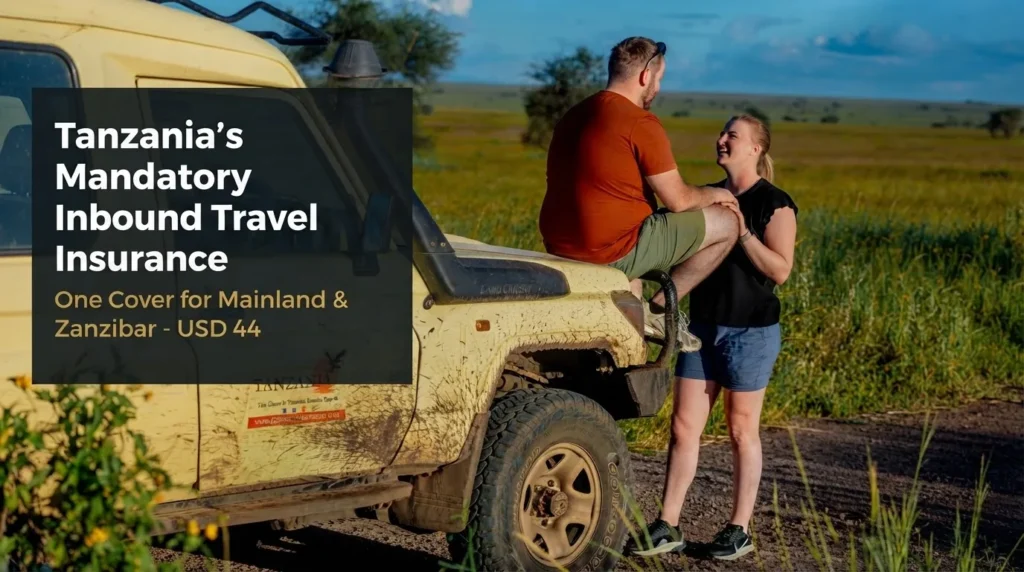
What exactly is Tanzania’s Mandatory Travel Insurance?
Tanzania’s mandatory travel insurance is a government backed, minimum coverage policy that nearly all foreign, non-resident visitors must hold to legally enter the country. It was created under Section 134A of the Insurance Act, a provision inserted by Tanzania’s Finance Act 2025, which took effect on 1 July 2025, and the operational detail was filled in over a year later when the Insurance (Inbound Travel Insurance) Regulations, 2026 were published in Government Notice No. 256 of September 4, 2026. It sits alongside but is legally separate from the private travel insurance policy that travelers buy from their home countries.
This travel insurance is not an optional upsell at immigration but it is designed to function as a border requirement and foreigners who arrives in mainland Tanzania without a valid inbound travel insurance certificate may be denied entry in the near future.
What does the mandatory policy actually cover?
The mainland scheme’s minimum coverage requirements fall into four categories set out in the September 2026 regulations: emergency medical treatment, emergency medical evacuation, emergency repatriation, and loss of luggage. Specific limits, benefit amounts, and exclusions for each category must be stated in the certificate issued to the traveler, but the regulations themselves only define the minimum categories, not generous coverage amounts.
Below is a down of what each category is meant to address:
-
Emergency medical treatment
This caters for urgent medical care needed during your stay such as a twisted ankle on a game walk, malaria, a scorpion sting, allergies, among others. This is intended to ensure access to healthcare services in case of illness or injury during the stay.
-
Emergency medical evacuation
This caters for transportation to an appropriate medical facility in cases of critical conditions, following a first aid to the appropriate health facility anywhere in the country. Often, the nearest proper hospital can be about two hours flight away.
-
Emergency repatriation
This caters for the return of the remains of a visitor or medical repatriation in the worst-case scenario.
- Loss of luggage
This caters for compensation for lost, stolen, or misplaced baggage.
Who Is Exempt from Tanzania’s Mandatory Travel Insurance?
Residents of East African Community (EAC) and Southern African Development Community (SADC) member states are exempt from the mainland scheme. Importantly, the regulatory text specifically exempts residents of EAC or SADC states not simply nationals or passport holders of those countries. This aligns with Tanzania’s existing regional commitments within the EAC bloc.

- A German passport holder who legally resides in Kenya or Rwanda (both EAC members) may qualify for exemption based on residency, not nationality.
- A British, American, Australian, Canadian, or other non-EAC/SADC resident traveler including European, North American, and Asian nationals will not be exempt, regardless of any prior travel history to the region.
Where is the mandatory Tanzania insurance purchased?
This insurance policy can be purchased either before departure or at the point of entry, after which the insurer must issue a certificate in electronic or paper form. It is administered by the National Insurance Corporation (NIC) of Tanzania or by registered insurers operating in partnership with the NIC. As of late September 2026, a dedicated, confirmed online purchasing platform for international travelers has not yet been rolled out, which is one of the main open questions the industry is waiting on.
Until Tanzania’s mainland platform and enforcement date are formally confirmed, travelers are advised not to prepay for anything related to this scheme from a third-party website.
What should a genuinely good Tanzania safari insurance policy include?
In addition to the mandatory inbound travel insurance issued by the government, here is a checklist travelers can use for their personal insurance.
- Emergency medical evacuation of at least USD 100,000–250,000 specifically naming air ambulance and helicopter evacuation from remote or bush locations, and not just medical transport in general terms.
- Repatriation of remains and medical repatriation, with no exclusion for the region.
- High altitude hikes covering to at least 6,000m if Kilimanjaro is on your itinerary.
- Named coverage for specific safari activities such as game drives, walking safaris, hot air ballooning, boat safaris since some generic policies exclude adventure activities by default.
- Scuba diving and water sports cover if you’re adding Zanzibar, Mafia, or Pemba.
- Trip cancellation and interruption, reimbursing non-refundable deposits if illness, a family emergency, or a natural event force you to cancel or cut your trip short.
- Baggage and gear loss with a realistic per-item limit, especially for camera equipment.
- A 24/7 multilingual emergency assistance line that can coordinate directly with your ground team. This is the detail people forget to check until they need it at 2am from a tented camp with patchy signal.
- Pre-existing condition coverage such as health conditions if relevant, reviewed and disclosed honestly at the time of purchase.
Can this insurance be purchased earlier before arrival, or can it be purchased on arrival?
The regulations allow purchase either before travel or at the point of entry, with the insurer issuing an electronic or hard copy certificate. A dedicated, confirmed international purchasing platform has not been announced yet as of late September 2026, so travelers are advised to wait for official confirmation of the purchase channel rather than buying it from third party sites claiming to sell it in advance.
What happens if a traveller has a travel insurance from their home country. Do they still need Tanzania’s mandatory policy?
Yes. The mandatory mainland scheme is a separate legal requirement issued by the National Insurance Corporation or a registered partner insurer, and it does not appear to accept proof of an equivalent foreign policy as a substitute, based on the regulations published so far. Many visitors already carry private insurance from home, but the government has maintained that its own coverage is a distinct requirement, similar to how Zanzibar’s existing scheme remains compulsory even for travelers who already hold private medical or travel insurance.
Is the mandatory insurance the same thing as travel medical insurance?
No. The mandatory policy is a minimum, government-defined entry requirement covering four broad categories emergency medical treatment, emergency medical evacuation, emergency repatriation, and loss of luggage without published benefit limits. A comprehensive private travel insurance or safari insurance policy typically offers much higher medical and evacuation limits, trip cancellation protection, and activity specific cover for things like trekking and diving, which is why we recommend both.
Does the mandatory travel insurance apply to children as well?
Under Zanzibar’s already operating scheme, children aged 3 to 17 pay a reduced fee of USD 22, and infants under 3 are exempt. The mainland scheme’s final child pricing structure had not been separately been confirmed in the regulations by September 2026 regulations, so it is advisable that families check the latest confirmed rates before travel.
Why is Tanzania introducing mandatory travel insurance now?
The goal for the insurance is to enhance tourist safety and reduce the strain on local healthcare systems by shifting the cost of emergency medical care onto a structured insurance framework rather than the Tanzanian state. Tanzania’s move follows a regional trend, with Kenya, Zimbabwe, Ethiopia, and Mauritius introducing or attempting similar schemes around the same period, and has been built directly on Zanzibar’s own scheme, which has been running successfully since October 2024.
Are medical facilities in Tanzania’s national parks good enough that evacuation cover is not required?
No, this is one of the most important things to understand before you travel. Facilities inside parks themselves are limited to basic first-aid at camps and lodges; serious cases are stabilized on-site and then flown to referral hospitals in Arusha, Dar es Salaam, or beyond. This is precisely the gap that emergency medical evacuation coverage exists to close.
What form of proof of the mandatory insurance is required at the border?
The regulations state that the insurer must issue a certificate in either electronic or paper form once the policy is purchased whether that purchase happens before departure or at the point of entry.
Tanzania’s mandatory travel insurance is real, legally in force, and likely to become an active border requirement in the near months but as of late September 2026, it isn’t yet something travelers are stopped and checked for at the Tanzania borders. What has not changed, and never will, is the need for genuine, comprehensive travel and medical evacuation insurance suited to what a Tanzania safari actually involves: remote parks, light aircraft transfers, high altitude hikes, and open water.