
How difficult is gorilla trekking?
How difficult is gorilla trekking?, Mountain gorillas live in the dense rain forests of Volcanoes national park, Bwindi impenetrable national park and Mgahinga national park. While mountain gorilla trekking is considered one of Africa’s most unforgettable safari experiences, the protected areas where they are visited comprise uneven terrain, high humidity, and high altitudes that can reach up to 3,000 meters making gorilla trekking not a walk in the park. Whether trekking gorillas in Uganda or Rwanda, gorilla trekking is an adventure that offers a blend of strenuous hikes with an extraordinary rewarding experience.
The level of difficulty of a gorilla trek varies depending on a number of factors, including your age, fitness level, assigned gorilla family, terrain, weather conditions, altitude, and how far the mountain gorillas have moved on that day. The level of challenges experienced varies for different visitors. Some visitors complete the trek in about two hours, while others hike for several hours (between 5-6 hours) before finally sighting the mountain gorillas. Gorilla trekking is not a race therefore there is no need to worry about how fast you can walk. The pace of the group is usually determined by its slowest member.
The minimum age for gorilla trekking in both Uganda and Rwanda is 15 years. This is a rule implemented to protect both the trekkers and the mountain gorillas as young children may find this trek physically demanding, and impossible to complete and may as well not be able to follow the code of conduct during the trek. This regulation helps to reduce the risk of disease transmission between the gorillas and humans since mountain gorillas are highly susceptible to human illnesses such as cold and flu. Additionally, it is also required that all participants are in good health before joining the trek.
Trans versing the steep, muddy trails through the breathtaking sceneries of the misty rain forests can be quite challenging with every step, however the moment you come face-to-face with the mountain gorilla family, the strenuous hike entirely becomes worthwhile as you watch them feed, groom, play, and interact in their natural habitat.
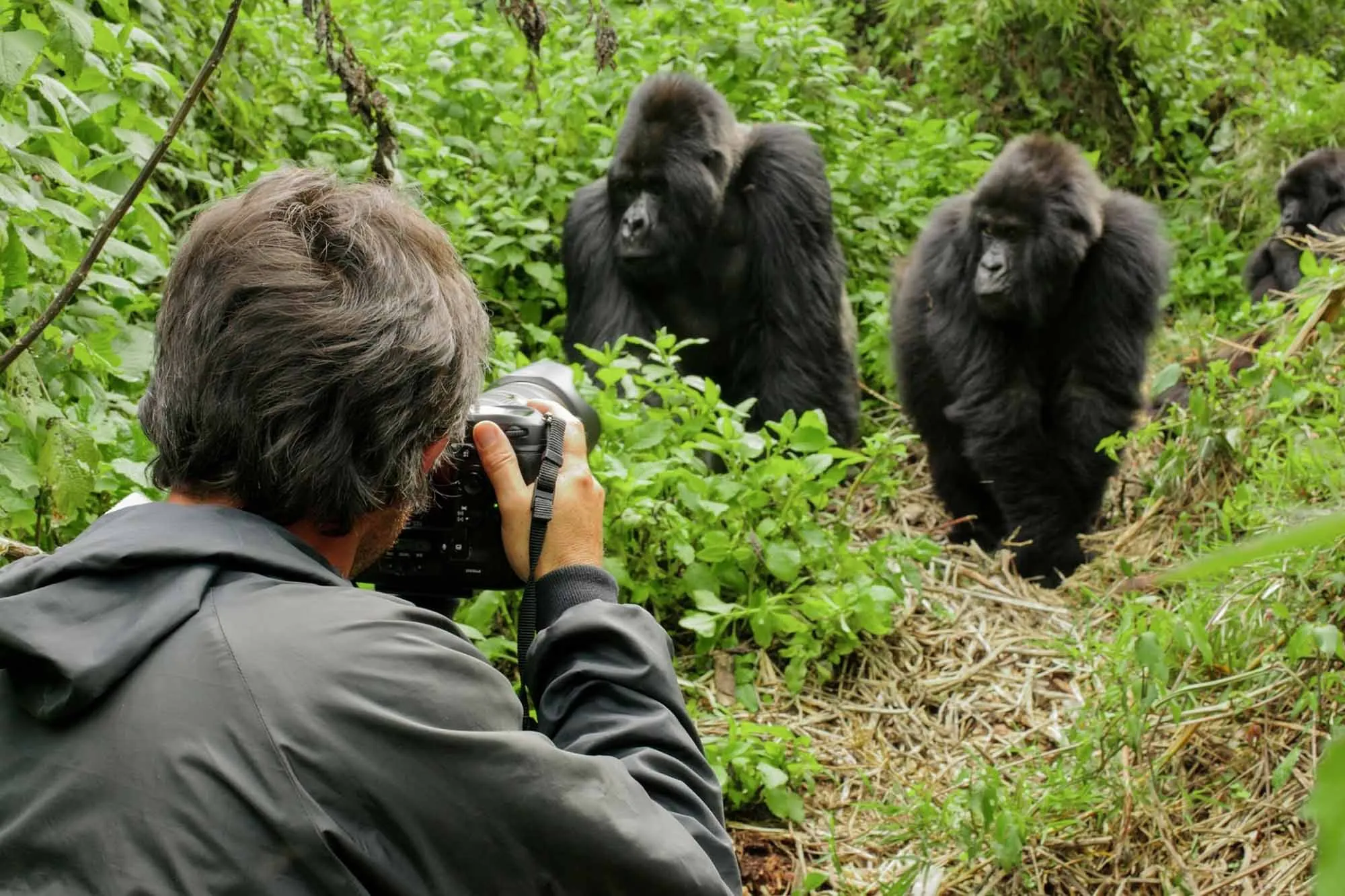 All in all, preparation is key to making the trek more comfortable and easier. Therefore, engaging in light exercises before the trip and having the proper dress code for the trek such as wearing proper hiking boots, layered clothing, rain coat, garden gloves, and carrying enough water makes a significant difference during the hike.
Even with the challenges encountered during the gorilla trek, most individuals with a moderate level of fitness can successfully complete it.
Gorilla trekking stages
The gorilla trekking hike is majorly divided into two portions.
The first part of the hike close to the forest boundaries. This hike lasts between 30 minutes to 1 hour depending on how fast the members of the group walk. This part of the hike is relatively easy and not too demanding since the terrain in these areas are relatively flat.
The second part of the trek is the actual challenging hike through the steep terrains leading to the gorillas. This is not as simple as the fast part therefore a certain level of fitness and flexibility is recommended. During this stage, the bushes are also thicker therefore scouts and ranger guides move ahead of you clearing the bush using a machete. The walk often lasts between 1 hour to 4 hours or sometimes even less depending on which gorilla family has been assigned to you and how far they had moved that day.
Despite the general moderate difficulty in the gorilla trekking hike, different individuals experience different level of difficulty depending on a number of factors such as;
 Age and Fitness level
Age and fitness play a very cruel role in determining the level of difficulty one experiences during the gorilla trek. This is particularly noticeable if trekking distant gorilla families that involves long hikes. Individuals that are moderately fit and under the age of 40 years experience less difficulty during the hike while those of 50 years and above largely find these hikes quite strenuous.
While these treks can be physically demanding especially to the older and unfit individuals, it is rare that individuals become overwhelmed by the hike to the extent that they choose to turn back before reaching the gorillas. The excitement and anticipation of seeing mountain gorillas in their natural habitat is a strong motivating factor that encourages trekkers to keep going despite the challenge and often they discover that they are actually very capable than they expected.
Location of the gorillas on that day
Before embarking on the trek, you are assigned a gorilla family to visit. This distribution is often done basing on age, fitness, health status, time available, and preferences of the trekkers. Gorilla families that are closer to the edges of the forest are easier to trek whereas gorilla families far from the edges of the forest are more challenging to hike and are characterized by longer treks.
It is however impossible to know with certainty where you will find the mountain gorillas on a specific day as they tend to move freely in their natural habitat making the shorter treks at times longer and the longer treks slightly shorter.
 Weather Conditions and Terrain
Contrary to the flat terrains with well paved roads most travelers are accustomed to, gorilla trekking is done within rain forests which are the habitats of these mountain gorillas. The terrain here is uneven and even get slippery especially during the rainy months of March, April, May, October, and November.
Wearing waterproof and sturdy hiking boots with good friction and ankle support will make a significant difference during your trek. If you would prefer to skip all the struggle that may come with the slippery terrain. It is recommended that you take your gorilla trekking safari in the dry season in the months of December to January and June to September.
Altitude
Gorilla trekking takes place at elevations of between 2500 to 3000 meters. This is not high enough to cause altitude sickness so there is no cause for alarm however the hike is still demanding especially for individuals coming from low altitude areas. For travelers concerned about the altitude, staying a day or two in these high-altitude areas will allow for you to acclimatize to the change in altitude before the actual trek.
 Hiring a porter
After the briefing for the gorilla trek, the ranger guides will give you a chance to hire a porter if you feel you need one before heading to the starting point of the trek and at the start of your trek, they will give each of you a walking stick. This is all aimed at making the hike manageable for you. These walking sticks give you a little extra stability during the hikes however it is barely enough to assist you manoeuvre the muddy rugged terrain moreso if you are under the weight of a backpack or carrying your photography equipment. Hiring a porter to assist with your luggage and provide an extra hand for support during the hike will make the gorilla experience less demanding.
These porters are members of the local communities surrounding the gorilla protected areas therefore hiring one will not only make your trek more manageable but also enable the local communities benefit directly from gorilla tourism and conservation.
