
Birdwatching in Uganda
Birdwatching in Uganda can turn an ordinary morning into a search for some of Africa’s most remarkable birds. One moment, you could be watching a shoebill standing motionless in a papyrus swamp; the next, you might be deep in a rainforest listening for calls from birds hidden high in the canopy.
Out on the savannah, colourful rollers flash across the grasslands, while in the mountains, specialist bird species reward those willing to venture into the highland forests.
 For a country roughly the size of Great Britain, Uganda has an extraordinary bird list, with around 1,060 recorded species. That richness comes from its remarkable mix of habitats: wetlands around Lake Victoria, tropical rainforests, open savannah, rivers, lakes and the high-altitude forests of the Albertine Rift. You do not have to travel across an entire continent to experience these different birding worlds.
A well-planned trip can take you from the famous shoebill habitats near Entebbe to the forests of Kibale and Bwindi, the open plains of Queen Elizabeth National Park and the remote wilderness of Murchison Falls or Kidepo Valley.
And the excitement is not reserved for expert birders carrying expensive equipment and years of experience. If you keep a life list, Uganda offers plenty of sought-after species to pursue.
If you are new to birdwatching, the sheer variety of shapes, colours, calls and behaviours makes every outing an opportunity to discover something unexpected. A knowledgeable local birding guide can help you identify what you see, find species that are easy to overlook and understand why particular birds live in particular habitats.
The secret is knowing where to go. Some places are famous for the shoebill, others for forest specialists, waterbirds or the birds of open grassland. Choose your birding destinations well, and Uganda becomes far more than a safari country, it becomes a journey through several very different bird worlds.
Why Uganda is so good for birds
Uganda’s birdlife is special because the country brings together habitats that are very different from one another. Tropical rainforests, open savannah, papyrus swamps, lakes and mountain forests all lie within a relatively small area.
The country sits between the bird-rich forests of Central Africa and the savannahs of East Africa, while the highlands of the Albertine Rift provide a home for species found nowhere else in the world.
That variety makes a birding trip here exciting. You could spend the morning looking for a shoebill in a wetland near Lake Victoria, then head into a forest to search for colourful turacos and other forest birds. In southwestern Uganda, the mountain forests of Bwindi and Mgahinga are especially rewarding for birders hoping to spot Albertine Rift endemics. Around 36 of these restricted-range species are reported to occur in Uganda, although the exact number varies with the checklist and classification used.
Another advantage is that many of Uganda’s best birding areas can be combined in one trip. With a well-planned route, visitors can explore wetlands, forests and savannah parks without having to cross enormous distances between every stop.
Some sites are also within reach of Entebbe and Kampala, making it possible to enjoy good birdwatching even on a shorter visit.
Local birding guides make the experience even better. Many are skilled at recognizing birds by their calls, helping visitors notice species that might otherwise remain hidden in thick vegetation or high in the trees.
Whether you are an experienced birder searching for a rare species or a beginner learning to tell one call from another, Uganda offers plenty to keep you looking, listening and discovering.
Mabamba Swamp: the shoebill
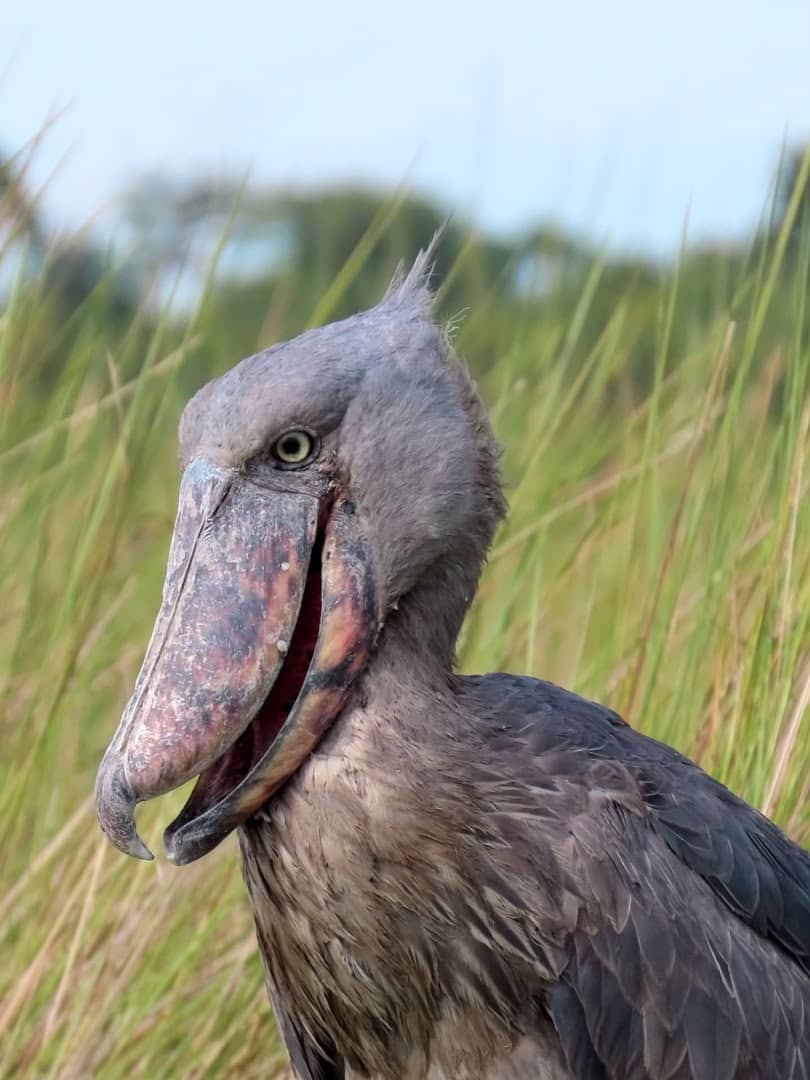
For many visitors, Mabamba Wetland near Entebbe is the main event. It’s a papyrus-lined swamp where the shoebill, a tall, grey, enormous-billed bird that looks closer to something from a prehistoric era than anything modern, can often be found standing motionless at the water’s edge.
You explore the swamp by narrow canoe, paddled by local guides, which suits the quiet approach the bird demands. Sightings aren’t promised, but the guides know the channels well, and the trip is short enough from Entebbe to do on your first or last morning.
Bring a hat, sun protection, and patience. Shoebills can stand still for a very long time, and a good photograph often comes down to waiting rather than moving.
Queen Elizabeth National Park
The Kazinga Channel boat cruise is one of the easiest ways to enjoy birdwatching in Queen Elizabeth National Park without setting out on a dedicated birding trip.
As the boat moves along the water, look towards the banks for African fish eagles perched above the channel, pied and malachite kingfishers hunting near the water, and pink-backed pelicans gathering along the shore.
You may also spot yellow-billed storks, saddle-billed storks, African jacanas, cormorants and black crakes. The mix of waterbirds makes the cruise rewarding, even before you count the hippos and crocodiles sharing the channel.
Birdwatching continues on the game drives. Across the open plains, keep an eye out for eagles, other birds of prey and species adapted to grassland, while the park’s wetlands and wooded areas offer a different mix of birds. With savannah, forest and water habitats all within the same park, there is always something different to look for.
Travellers who are not dedicated birders, Queen Elizabeth is an excellent place to start. You can enjoy a classic wildlife safari, take the Kazinga Channel cruise and still see an impressive range of birds along the way.
You do not need to spend the whole day searching the trees with binoculars; simply pay attention to the water, the shoreline and the skies, and the birds become part of the safari.
Bwindi and the Albertine Rift endemics
Bwindi Impenetrable National Park holds a large share of the Albertine Rift endemic birds, a group found only in the mountains along the western edge of the Rift Valley.
Birders often combine a gorilla trek with a day or two of forest birding in sectors such as Ruhija, known for its birding trails.
Forest birding here is slower and more demanding than open-country birding. Birds can be heard far more often than they are seen, and guides who recognize calls are worth every shilling.

Murchison Falls
The Nile delta area offers a second reliable chance at a shoebill, along with water birds, kingfishers, and bee-eaters, while the savannah side adds ground hornbills, raptors, and open-country species. It’s a good option for travellers building a mixed wildlife and birding itinerary.
Kibale and Semuliki
Kibale Forest is best known for primates, but its birdlife is rich, and the nearby Bigodi Wetland Sanctuary is a well-regarded community-run spot for walking birding.
Semuliki National Park, further west, protects lowland forest species more typical of the Congo Basin that are difficult to find elsewhere in Uganda.
Birding is good year-round, but timing affects what you’ll see. Migratory species from Europe and Asia arrive in the northern winter, boosting numbers in many areas, while the wetter months bring breeding activity and brighter plumage for many resident species. The dry seasons make trails and roads easier.
A decent pair of binoculars is the single most useful item, followed by a field guide or a bird-identification app downloaded before you travel.
 A light raincoat, neutral-coloured clothing, and a small notebook round out the kit. Many guides carry scopes, but it’s worth asking in advance.
A general safari driver-guide will help you see plenty, but a trained birding guide transforms the experience, particularly in forest where almost everything is identified by sound. Ask for one in advance, since the best are booked early.
For a short trip, a morning at Mabamba, a night near Queen Elizabeth, and a day or two at Bwindi cover a wide spread of habitats.
For a longer trip, add Murchison, Kibale, and Semuliki. Allow slack time, because birding rewards patience far more than speed.
If you’d like help building a route around the birds you most want to see, our team can match sites and guides to your list.