
Face to Face with Gorillas
There are moments in life that divide time into before and after. Standing in the misty highlands of Central Africa, face to face with a mountain gorilla, is one of them. Nothing prepares you for it. Not the weeks of planning, the pre-travel briefings, the photographs you have studied, or the wildlife documentaries you have absorbed over a lifetime. When you finally part the dense curtain of vegetation and find yourself within arm’s reach of one of humanity’s closest living relatives, the world as you know it contracts to a single, breathtaking point.
The gorilla does not flee. It does not roar. It simply looks at you with amber-brown eyes that hold an unsettling depth of intelligence, and in that gaze, you feel both the weight of millions of years of shared evolutionary history and a profound humility about your place in the natural world. This article takes you into that encounter: the preparations, the trek, the emotional reality of coming face to face with a gorilla, and the urgent conservation story that makes every such meeting precious beyond measure.
 Who Are the Gorillas?
Gorillas are the largest living primates on Earth, native to the tropical and subtropical forests of central sub-Saharan Africa. They belong to the genus Gorilla, which is divided into two species: the western gorilla (Gorilla gorilla) and the eastern gorilla (Gorilla beringei). Each species is further divided into two subspecies. The western gorilla comprises the western lowland gorilla (Gorilla gorilla gorilla) and the critically endangered Cross River gorilla (Gorilla gorilla diehli). The eastern gorilla includes the Grauer’s gorilla, also known as the eastern lowland gorilla (Gorilla beringei graueri), and the famous mountain gorilla (Gorilla beringei beringei).
Sharing approximately 98.3% of their DNA with humans, gorillas are our second-closest living relatives after chimpanzees and bonobos. This genetic proximity is immediately apparent when you observe them in person. They gesture, they express complex emotions through facial expressions, they play, they grieve, they nurture, and they form intricate social bonds that bear a haunting resemblance to our own.
Physical Majesty: Built for Power and Peace
Adult male gorillas, known as silverbacks due to the distinctive saddle of silver-grey hair that develops across their backs and hips at maturity, are awe-inspiring in their physical presence. A fully grown silverback can stand up to 1.8 metres (nearly 6 feet) tall when upright and weigh between 140 and 270 kilograms (310 to 595 pounds). Their arm span can exceed 2.6 metres. Their chest circumference, particularly during displays of dominance, seems barely believable. Yet for all this physical power, gorillas are, at their core, gentle vegetarians.
Female gorillas are considerably smaller, typically weighing between 68 and 113 kilograms. Young gorillas, called infants for their first three to four years and then juveniles, are irresistibly engaging: they tumble, wrestle, and cling to their mothers in ways that will remind any human parent of their own children. The social structure of a gorilla troop typically revolves around a dominant silverback, several adult females, their offspring, and occasionally subordinate males. The silverback is not merely a bodyguard; he is the navigator, peacekeeper, and emotional anchor of the entire group.
 The Habituated Gorillas and the Science of Tolerance
What Does Habituation Mean?
Not all gorillas can be visited. The gorillas that rangers, researchers, and tourists encounter are what scientists call “habituated” — groups that have been gradually exposed to human presence over a carefully managed period that typically spans two to four years. During habituation, teams of trackers and researchers spend time daily in the vicinity of a gorilla family, moving quietly, averting their eyes, and never threatening. Over time, the gorillas come to accept the presence of humans as non-threatening.
This process is painstaking and not without risk. Unhabituated gorillas can be dangerous when cornered or alarmed. But the result of successful habituation is remarkable: a window into wild gorilla life that has yielded some of the most important primate research in history, while also providing a controlled, sustainable form of ecotourism that funds conservation efforts.
The Golden Triangle: Uganda, Rwanda, and the DRC
Mountain gorillas exist in only two isolated populations in the world: the Bwindi Impenetrable Forest in Uganda (which also extends into a small section of the Democratic Republic of Congo), and the Virunga Massif, a chain of extinct volcanoes straddling Uganda, Rwanda, and the DRC. It is here, in these high-altitude forests where the air is cool and thin and the vegetation is impossibly lush, that gorilla trekking experiences are offered.
Rwanda’s Volcanoes National Park, Uganda’s Bwindi Impenetrable Forest National Park, and the Mgahinga Gorilla National Park are the primary destinations. Each offers a slightly different experience. Rwanda’s terrain is perhaps the most cinematic, the volcanic peaks and terraced hillsides creating a landscape that feels almost impossibly picturesque. Bwindi, with its ancient, tangled forest, is rawer and more challenging, but rewards visitors with an overwhelming sense of wilderness. Both are extraordinary.
Preparing for the Trek
The Permit: Your Most Precious Document
A gorilla trekking permit is among the most valuable and coveted wildlife experiences documents in the world, and with good reason. Access to each habituated gorilla family is strictly limited to one group of eight visitors per day. In Rwanda, a permit currently costs $1,500 USD per person. In Uganda, permits are priced at $800 USD. These fees are not merely commercial; they are a primary mechanism of conservation funding, channeled into park management, anti-poaching operations, community development programs, and veterinary support for the gorillas themselves.
 Physical Preparation and What to Expect
Gorilla trekking is not a casual stroll. Depending on where your assigned gorilla family has roamed, a trek can last anywhere from one hour to seven or eight hours of hiking through dense, uneven jungle terrain at altitudes ranging from 2,000 to 3,400 metres (6,560 to 11,155 feet). The elevation alone can be taxing. Add steep slopes, tangled roots, mud, stinging nettles, and dense undergrowth that must sometimes be cut through with a machete, and you begin to understand why fitness and proper preparation matter.
Recommended gear includes sturdy, ankle-supporting waterproof hiking boots, long-sleeved shirts and long trousers to protect against nettles and insects, a waterproof jacket or poncho, lightweight gloves, a hat, and gardening gloves for grabbing thorny vegetation. A good daypack containing at least 2 litres of water, snacks, a basic first aid kit, insect repellent, and a camera with a capable low-light sensor rounds out the essentials. Many trekkers choose to hire a porter from the local community, a practice that is warmly encouraged as it provides direct economic benefit to villages that have historically lived alongside (and sometimes in conflict with) gorilla populations.
The Day of the Trek
Pre-Dawn Anticipation
You wake before the light comes. The air at altitude is cool and carries the faint scent of wood smoke and wet earth. The lodge or camp is hushed, and as you dress in the predawn darkness, there is a particular quality of anticipation that is difficult to describe. It sits somewhere between nervousness, reverence, and pure excitement. You have come thousands of miles for this day. You have read about it, imagined it, perhaps dreamed of it. And now it is real.
At the park briefing centre, your group gathers with a park ranger and receives a final orientation. The rules are reiterated with calm authority: you will maintain a distance of at least seven metres from the gorillas at all times; you will not eat or drink in their presence; if a gorilla charges or approaches, you will not run, but will crouch submissively and avert your gaze; you will not point directly at them; any flash photography is forbidden; and if you feel unwell with a cold, cough, or respiratory illness, you will not enter the forest. Gorillas are highly susceptible to human diseases, and a single transmission can devastate an entire family.
Into the Forest
The trek begins at the forest edge, where the cultivated hillsides of farms and homesteads give way abruptly to a wall of ancient vegetation. The transition is startling. One step you are in a human landscape; the next, you are in something primordial and wholly other. The canopy closes overhead. Light filters down in scattered shafts. The sounds of the human world fade and are replaced by bird calls, the drip of moisture from leaves, the rustle of unseen creatures in the undergrowth.
Your lead tracker has been out since before dawn, following the gorilla family from where they nested the previous night. Communication crackles over a handheld radio: the gorillas are moving uphill, through a section of thick Hagenia woodland. The group adjusts its trajectory accordingly. There is a certain breathless poetry to this pursuit, this following of a living thread through an ancient forest. Your tracker reads the land the way some people read books, every broken branch and knuckle print in the mud a sentence in a language you are only beginning to learn to decipher.
The Encounter
First Contact
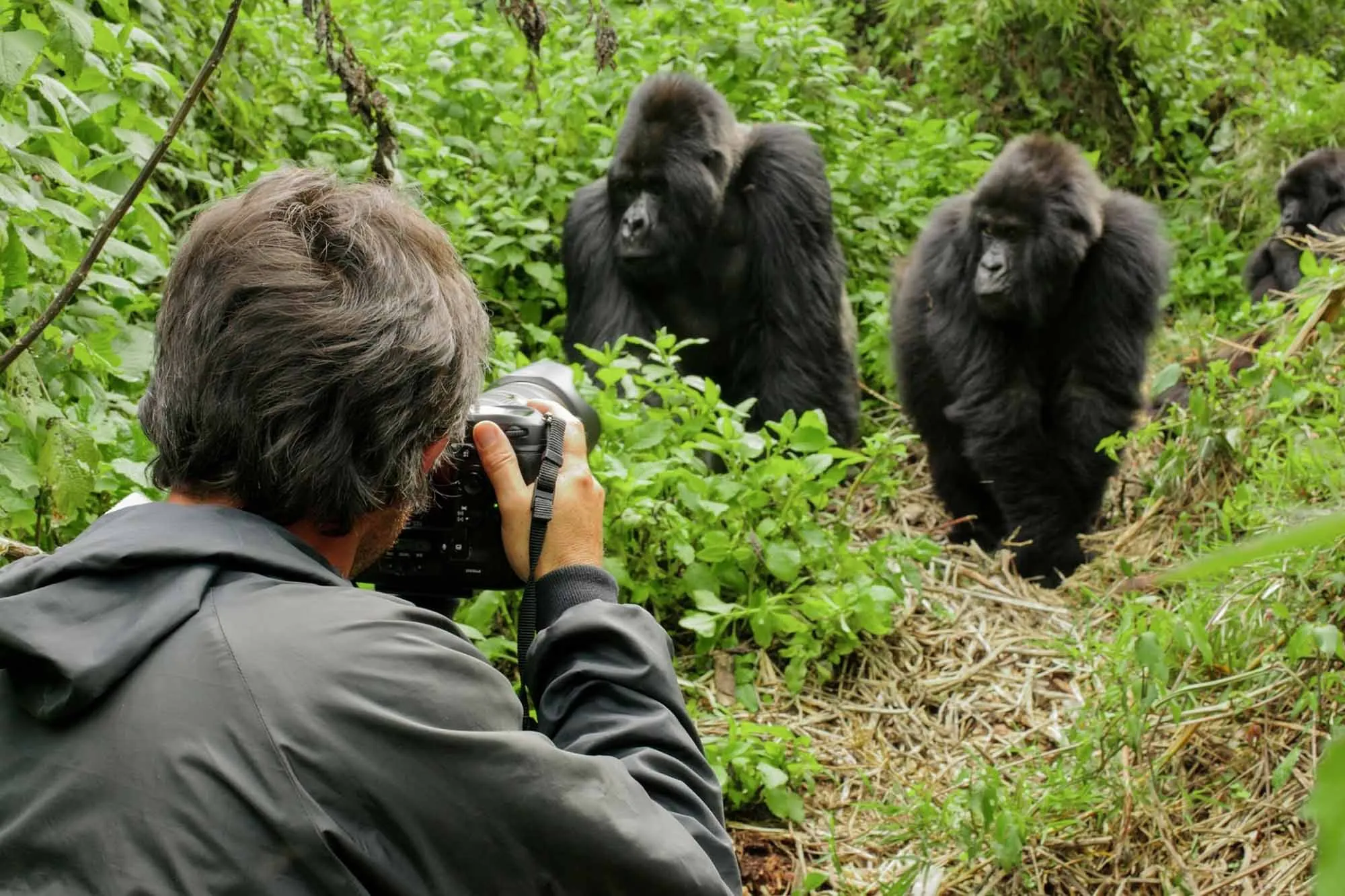
There is rarely a dramatic moment of discovery. More often, the gorillas simply materialise. One moment you are pushing through dense vegetation, and then the tracker raises a quiet hand and you freeze. Through a gap in the leaves, perhaps three or four metres ahead, a black shape resolves itself. A young gorilla sits in the crook of a branch, methodically pulling leaves from a stem and eating them with complete, unhurried confidence. It knows you are there. It has known for some time. It is simply not remotely concerned.
Your heart is beating audibly. Everything you planned to do, every photograph you intended to take, every clever observation you had prepared, evaporates completely. You simply stand, rooted, and look. And breathe. The juvenile gorilla glances at you with brief, appraising curiosity, then returns to its meal. Somewhere deeper in the vegetation, you hear the steady rhythm of knuckle-walking on earth, the sound of large bodies moving with unhurried purpose.
The Silverback: A Presence Like No Other
When the silverback appears, everything changes in quality. He does not burst from the undergrowth. He simply arrives, as though he has always been there and you are only now capable of perceiving him. He is enormous. Even if you have studied photographs, even if you knew intellectually what to expect, nothing truly prepares you for the sheer physical reality of a fully grown silverback. The breadth of his shoulders. The casual, absolute power in the way he moves. The silver-white saddle of hair that gives the sunlight something to cling to.
He settles onto his haunches a short distance away and surveys his family with quiet authority. Then he looks at you. Not through you, not past you: at you. The directness of his gaze is almost unbearable in its intimacy. It is an assessing, steady, intelligent look, entirely devoid of aggression but carrying an unmistakable weight of presence. In that moment, every philosophical question about the boundary between human and animal seems both urgent and somehow beside the point. You are not the apex predator here. You are the visitor. And you are being judged.
The Family: Life in Real Time
As your eyes adjust and your nervous system settles into something closer to calm, you begin to take in the whole family. There, close to the silverback, is a mother with an infant clinging to her chest, its tiny face peering out at the world with wide, astonished eyes. Two juveniles are engaged in a wrestling match that tumbles them through the vegetation with complete disregard for direction. An adolescent male sits apart, pulling thoughtfully at a stalk of wild celery, affecting the detached air of a teenager who is far too cool to be seen caring about anything.
A female grooms a companion with focused, careful attention, separating the hairs one by one, as though she has all the time in the world and no place else she would rather be. In the background, the silverback makes occasional low, rumbling vocalisations, a sound that vibrates in the chest as much as the ears, a sound that communicates contentment, authority, and presence all at once. Every so often, he will shift position or beat his chest briefly, not in aggression but as a reminder: I am here. All is well. I am watching.
The Charge: When Boundaries Are Tested
Not every encounter passes in peaceable observation. Gorillas are wild animals with their own protocols and thresholds, and occasionally, usually through a misunderstanding of proximity or a sudden movement that triggers an instinctive response, a gorilla will charge. For first-time trekkers, this is among the most terrifying experiences imaginable.
A charge is rarely a full commitment. Most often it is a bluff: a thunderous rush of perhaps ten or fifteen metres, accompanied by vocalizations that shake the air and a ground-shaking display of raw power. The correct response, every briefing emphasizes, is to crouch, look away, and hold your ground. Every instinct screams at you to run. You must not. Running triggers pursuit. The gorilla is testing, and the appropriate response is submission: I am no threat. I defer to you. The charge nearly always stops short. The gorilla returns to his family. Your legs, if you are honest about it, may never fully stop shaking.
 The Hour That Changes Everything
Park regulations allow a maximum of one hour in the presence of the gorillas. Sixty minutes. In ordinary life, an hour can disappear in a stream of emails and notifications. Here, it expands into something profound and strange. Every minute has a texture and a weight. You are hyper-aware of everything: the sound of your own breathing, the way the light falls through the canopy, the distance between yourself and the nearest gorilla, the expression on the silverback’s face as he watches his family.
Many visitors report that they forget entirely to take photographs for the first fifteen or twenty minutes, so completely are they absorbed in the simple, overwhelming fact of being there. Others find themselves unexpectedly emotional, not with sadness but with something harder to name: a sense of recognition, perhaps, or of connection to something older and larger than the world of human concerns that normally fills every waking hour.
And then, as the tracker signals quietly that the hour is up, you turn and begin the walk back through the forest, and the gorillas continue their day as though you were never there. Which, in a sense, is entirely the point.
The Mountain Gorilla’s Story of Survival
On the Edge of Extinction
The mountain gorilla’s story is inseparable from the story of human impact on the natural world, but it is also, remarkably, a story of hope. In the 1980s, mountain gorilla numbers had fallen to an estimated 254 individuals. The combined pressures of habitat destruction, poaching, disease transmission from humans, and the devastating effects of civil conflict in the region had pushed the species to what seemed like an irreversible edge.
The mountain gorilla is the only great ape whose wild population has increased in recent decades, a fact that conservationists describe with cautious, hard-earned pride. As of the most recent comprehensive census, conducted across the entire mountain gorilla range, the global population has grown to over 1,000 individuals. This is extraordinary. It does not make the species safe, it remains listed as Endangered by the IUCN, and every individual matters, but it represents one of conservation’s genuine victories.
The Pillars of Recovery
The recovery of the mountain gorilla has been achieved through a combination of factors that offer lessons for conservation efforts worldwide. International research programmes, most famously the Dian Fossey Gorilla Fund founded in the legacy of the murdered primatologist who dedicated her life to these animals, have provided critical scientific foundations for understanding gorilla ecology, behaviour, and health needs.
Robust anti-poaching efforts coordinated across three national governments have reduced direct hunting pressure significantly. Veterinary intervention teams stand ready to treat injured or ill gorillas, a remarkable and controversial practice that has saved individual animals and, in some cases, entire family groups. And ecotourism, despite its inherent tensions around wildlife disturbance, has proven to be among the most powerful tools for conservation by making living gorillas dramatically more economically valuable than dead ones, and by building local communities into genuine stakeholders in the gorillas’ survival.
The Ongoing Threats
Despite the progress, the threats to mountain gorillas remain serious and multifaceted. Habitat loss continues as growing human populations press against the boundaries of gorilla territories. Climate change is altering the high-altitude ecosystems on which mountain gorillas depend. Disease, particularly respiratory infections transmitted from humans, represents a constant and deadly risk; a single outbreak of measles, pneumonia, or even a common cold can sweep through a gorilla family with lethal efficiency.
Political instability in the eastern DRC has at various times endangered both the gorillas and the rangers who protect them. Park rangers in the Virunga National Park have died defending gorillas from armed groups who operate within the park’s boundaries. Their courage and sacrifice represent perhaps the most profound and underreported dimension of gorilla conservation.
The Ethics of the Encounter
Is Gorilla Trekking Ethical?
The question is legitimate and deserves honest engagement. Critics of gorilla trekking raise several concerns. The process of habituation itself necessarily changes the gorillas’ relationship with humans, potentially reducing their natural wariness toward people in ways that could increase their vulnerability. The disease risk from close human contact is real and well-documented. The tourist groups, however small and carefully managed, introduce noise, physical disturbance, and stress into the gorillas’ environment. And some argue that the commercialization of wildlife encounters is philosophically troubling regardless of its conservation outcomes.
Defenders of responsible gorilla trekking programmers offer compelling counter-arguments. The conservation funding generated by permit fees is not merely significant: in some years, it has been the primary financial mechanism sustaining the protected areas in which gorillas live. Without tourism revenue, the parks would be chronically underfunded, anti-poaching efforts would collapse, and the pressure to convert gorilla habitat to agricultural land would be irresistible. The gorillas’ survival in these parks is, in a very real sense, financed by the fees paid by visitors who want to look into their eyes.
 How to Tread Lightly
The ethical dimensions of gorilla trekking are not resolved by the decision to go; they are a responsibility that continues through every aspect of the visit. Choosing operators with genuine conservation credentials rather than those who priorities profit over animal welfare matters. Respecting every rule with absolute seriousness, including the distancing requirements, the silence protocols, and the health restrictions, is not a bureaucratic inconvenience but a direct contribution to gorilla welfare. Engaging with local communities by hiring local guides and porters, buying local products, and supporting community-based projects extends the economic benefits of tourism beyond the park gates and into the human landscape that ultimately determines the gorillas’ fate.
Voices from the Encounter
No account of gorilla trekking is complete without the human testimony of those who have made the journey. The responses are remarkably consistent across cultures, ages, and backgrounds. Something shifts in people when they come face to face with a gorilla. Here are some of the responses that capture the experience most authentically:
“I had not cried in years,” one visitor recalled. “I am not someone who cries. But when the silverback looked at me, I felt something open up. Not sadness, exactly. More like recognition. Like looking into a mirror that shows you something true about yourself.”
A wildlife researcher described her first encounter outside of professional observation: “I have spent years studying primates in controlled settings. Nothing prepared me for the emotional force of simply being there as a person, not a researcher, not behind glass. When a juvenile walked toward me and sat down less than two metres away and just… looked at me, I forgot everything I thought I knew. I was just a primate meeting another primate.”
A conservation donor who had funded gorilla protection programmed for a decade before visiting described it simply: “I understood before. But I did not feel it before. I feel it now. For the rest of my life, I will feel it.”
After the Encounter
The Walk Back
The trek back from the gorillas often passes in a particular kind of silence. People who were strangers at dawn find themselves sharing something intimate and unrepeatable, a shared experience that needs no comment. The forest, which felt so impenetrable on the way in, now seems to open gently around you, as though the act of bearing witness has granted you a temporary permission to be here. You notice things you missed before: the orchids clinging to the mossy tree trunks, the iridescent flash of a sunbird in the canopy, the way the mountain mist drifts through the Hagenia trees like something from a half-remembered dream.
What You Carry Home
The effects of the encounter tend to linger in ways that surprise people. Many visitors return home with a significantly altered relationship to environmental issues that previously felt abstract. The gorillas become personal. Their vulnerability becomes personal. The forests of Central Africa, which most people have never visited and might never visit again, become places with faces in them, places that belong to someone who looked you in the eye and was not afraid.
This transformation is not incidental to the conservation mission. It is central to it. The gorillas who tolerate our presence, who allow us those sixty extraordinary minutes, are doing something that no wildlife documentary can quite replicate: they are making the abstract concrete, the distant intimate, the invisible visible. They are making us care. And caring, in the end, is what conservation requires more than anything else.
Conclusion: A Mirror in the Mist
Face to face with a gorilla, everything you thought you knew about the boundary between human and wild is gently but irrevocably revised. These are not simply animals. They are not simply our ancestors or our evolutionary cousins. They are contemporaries: beings who have been living in these forests for as long as our own ancestors have been walking the savannahs, beings who have developed their own cultures, their own emotional lives, their own forms of intelligence and kinship.
The mountain gorilla’s improbable survival story is one of the few genuinely encouraging environmental narratives of our time. It tells us that the trajectory of decline is not always irreversible, that with adequate funding, sustained commitment, political will, and the quiet heroism of the trackers and rangers who dedicate their lives to these animals, recovery is possible. It tells us that people, when they encounter wildness directly, are capable of extraordinary acts of care.
But it also tells us, with the unblinking honesty of a silverback’s gaze, that there is no room for complacency. The gorillas remain endangered. Their forests remain threatened. Their future remains uncertain. They are living at the intersection of human power and human responsibility, and what happens to them is, in every meaningful sense, a choice that we make, or fail to make, every single day.
Go, if you can. Follow the trackers into the mist. Stand in silence in the heart of the ancient forest. Let yourself be seen by a silverback’s eyes. And carry what you find there back into the world with you, and let it change how you live in it.
Quick Reference: Gorilla Trekking at a Glance
Best Time to Visit: June to September (dry season) and December to February. Trekking is possible year-round, but dry season trails are less arduous.
Permit Costs (approx.): Rwanda: USD $1,500 | Uganda: USD $800 | DRC: USD $400. Prices subject to change.
Group Size: Maximum 8 visitors per gorilla family per day.
Time with Gorillas: Strictly limited to 1 hour once the family is located.
Trek Duration: Variable: 1 to 8 hours depending on gorilla family location. Average is 3 to 5 hours.
Minimum Age: 15 years old (Rwanda and Uganda).
Health Requirement: Visitors must be free of colds, flu, and respiratory illness. This rule is strictly enforced to protect gorilla health.
