
Gorilla families in Rwanda
Sited along the foothills of the Virunga mountain ranges in the far northwestern Rwanda in a Musanze district, Volcanoes national park is home to one of the world’s most iconic yet endangered species. Rwanda is one of the three countries where one can see these gentle giants in their natural habitat alongside Uganda and the Democratic Republic of Congo.
Mountain gorillas live in groups of between 5 to 30 members though on average a typical gorilla family consists between 10-15 members often led by a dominant male known as the silverback.
Volcanoes national park has 13 habituated gorilla families that are open for visiting throughout the year depending on the availability of the gorilla permits. These are the Susa group- the famous family that was studied by Diane Fossey, the Amahoro family, the Karisimbi family, the Isimbi family, the Igisha family, Umubano family, Sabinyo family, Agashya family, Muhoza family, Hirwa family, Kwitonda family, Kwisanga and Kigomo family.
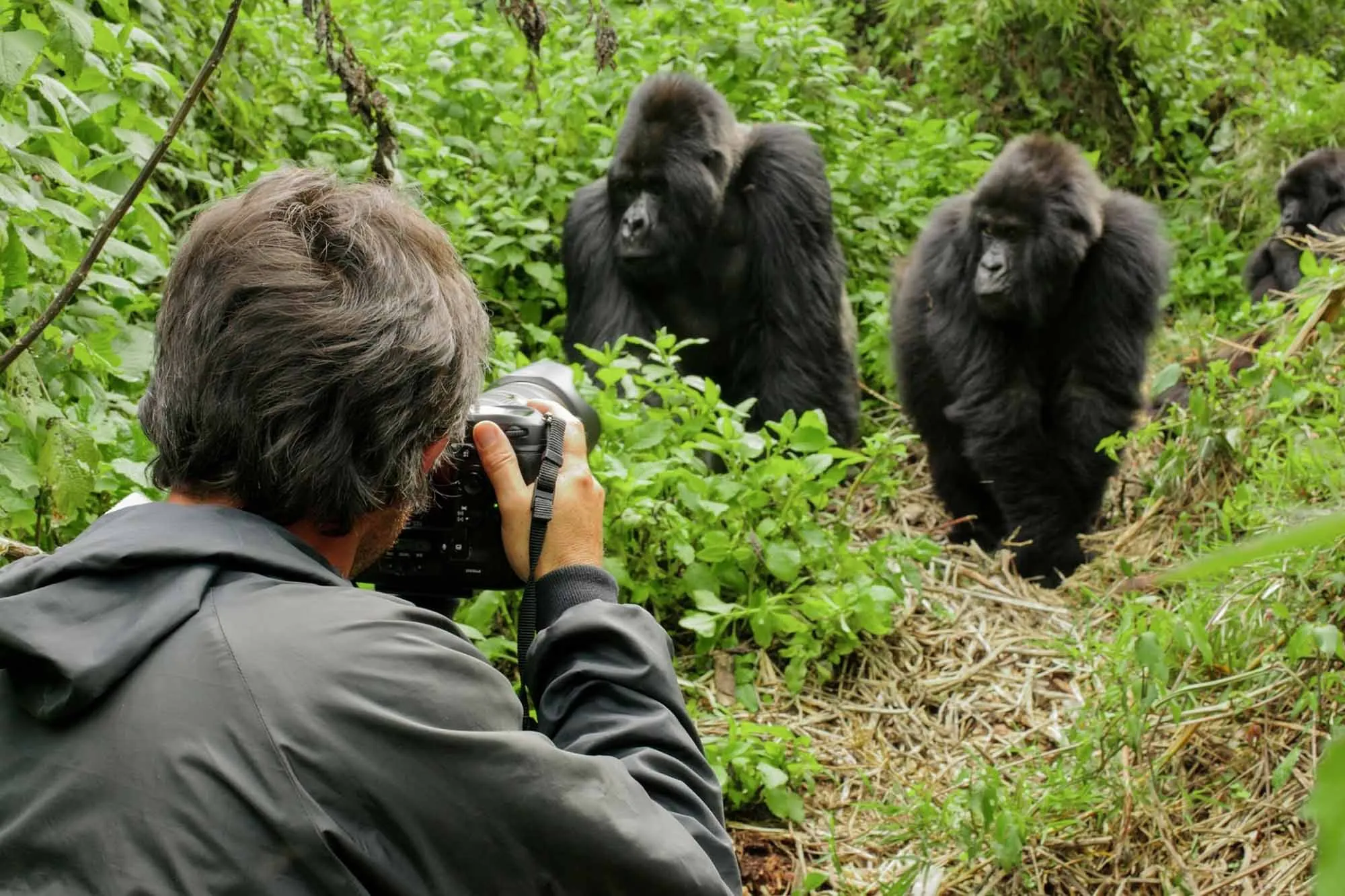 The dynamics of the mountain gorilla family
Mountain gorillas live in groups structured around social hierarchy with these groups being led by a dominant silverback whose major role is to lead and protect its group. The number of mountain gorillas in each group range from 5 to 30 members and these include the famous dominant silverback, the adult females, black backs and the infants/babies. The silverback has full authority over all the members of his group therefore takes up the major responsibilities such as decision making, defending the group against threats, and resolving conflict. Within these families, relationships are maintained through social interactions such as playing, grooming, feeding, among others. This intricate social structure is essential for the survival and stability of mountain gorilla communities, due to their complex and highly developed social behaviour.
While there is always stability in these groups /families as the silverbacks make the final decisions on behalf of the group, just like in any setting, social dynamics of these groups sometimes shift and this particularly happens as the black backs approach maturity and eventually start challenging the authority of the silverback with the intention of either over throwing him or forming their own families.
-
The Susa Family
This is the legendary gorilla group that was studied by the famous primatologist Diane Fossey between the years of 1968 and 1985. The Susa group was formed in the year 1974 and was named Susa after a local stream that runs through the region where this gorilla family calls home. This gorilla group is renowned for its large size, boosting of up to 42 members including the first surviving mountain gorilla twins, Impano and Byishimo. These twins were named so in the 2005 Kwita Izina ceremony by Rwanda’s first family.
In 2009, the Susa family split into four forming the Susa, Karisimbi, Isimbi, and Igisha groups/families. As of today, the surviving Susa group is led by a dominant silverback Impuzamahanga, and it consists 19 members, 3 silverbacks, 3 infants, and 5 adults and the group continues to thrive on the slopes of the famous mount Karisimbi.

-
The Karisimbi family
Originally known as the Susa B, the Karisimbi group came into existence in 2009 after the splitting of the main Susa gorilla family. The Karisimbi/ Susa B was formed under the leadership of Nyagakangaga comprising 13 individuals.
This group was named the Karisimbi group in 2010 after the famous Karisimbi mountain on whose slopes they inhabit.
In April 2012, due to conflict within this group, some of the members of this group moved forming the Isimbi group. To-date, the Karisimbi family comprises 10 individuals, with 6 silverbacks.
The Karisimbi group is also referred to as a cross-border group ranging between Volcanoes national park and Virunga national park.
-
The Isimbi family
The Isimbi group was formed under the leadership of the dominant silverback Getty, after breaking off from the Karisimbi gorilla group. Getty later died in 2013 leaving the group under leadership of the new silverback Muturengere who until to-date has maintained stability in this group. As of the moment, the Isimbi group comprises 16 members, 4 adults and 4 infants.
-
The Igisha family
The Igisha group was formed in November 2014 after the spitting of the Susa family, making it the recent break off from the original Susa family. The Igisha family is led by the dominant silverback Igisha hence the name of the group. The Igisha group started with a total of 23 members and ever since it has grown to its current size of 33 members making it one of the largest gorilla families in Volcanoes national park.
Due to the diversity of the members of this group, its offers one of the best gorilla trekking experiences allowing visitors to observe the true lifestyle of the gorillas.

-
The Amahoro family
True to its name Amahoro which means peaceful, the Amahoro gorilla group is the most amicable group in Volcanoes national park. In 2002, following the death of the dominant silverback, the Amahoro group split into 2 groups one of which is the current Amahoro group under the leadership of Ubumwe.
As of to-date, the Amahoro family under the leadership of Ubumwe inhabits the slopes of mount Bisoke and comprises 29 members including 4 silverbacks.
-
The Umubano family
Formed after the splitting of the Amahoro family, the Umubano group comprises 14 members, including 8 silverbacks and is led by dominant silverback called Charles and they inhabit the slopes of mount Bisoke. The name Umubano means togetherness and co-operation.
-
The Sabinyo family
Led by the dominant silverback Gihishamwotsi who took over leadership of the group after the death of his father Guhonda in 2020, the Sabinyo group currently comprises 15 members. Before coming to be known as the Sabinyo group, this group was originally called the Amavubi family, a name meaning wasps due to its aggressive nature. The Sabinyo family resides around mount Sabinyo carrying a long history dating back to its habituation in 1987.
-
The Agashya family
Originally known as group 13, the Agashya group is famous for its fascinating story of leadership. This group was named Agashya after the silverback that took over the leadership of the group following his epic battle with then the leader of the group Nyakairima where he emerged victorious.
Under the leadership of Agashya who ensures continuous survival of this group, the group has increased from 12 to 19 members.
-
The Muhoza family
The Muhoza group was formed in 2015 when the silverback Marambo left his group and after wandering by himself for almost an entire year, he settled down attracting females from other gorilla groups such as the Agashya and Hirwa groups.
As of today, the Muhoza family comprises 19 members and inhabit the valley between mount Bisoke and mount Sabinyo.
-
The Hirwa family
The Hirwa group was first spotted in 2005 under the leadership of the silverback Munyinya, who had initially moved away from the Susa group. The name Hirwa means lucky and this group was named so due to his combined history of tragedy and resilience. The Hirwa group is one of the three gorilla groups in volcanoes national park with twins.
In 2019, the Hirwa group crossed over from Volcanoes national park into Mgahinga national park in Uganda where it tragically lost four members including Munyinya during a lightning strike. Despite this loss, the Hirwa group returned to Volcanoes national park where they continue to thrive with up to 13 members under the leadership of the dominant silverback Uburanga.

-
The Kwitonda family
Originally from the Democratic Republic of Congo, the Kwitonda group relocated to Volcanoes national park in 2004 after the death of the dominant silverback Kwitonda in 2012. After this death, the subordinate silverbacks Akarevuro and Kigoma took over the leadership of the group and then in 2021 it peacefully split into two groups each comprising 20 members. As of today, the Kwitonda group consists of 19 members and continue to thrive under the leadership of Akarevuro.
-
The Kwisanga
This is the gorilla group formed as a result of the splitting of the Kwitonda group in May 2021. The name Kwisanga means welcome and the group was named so due to the friendly nature of its members. This group inhabits the area around mount Sabinyo and over the years has thrived under leadership of two different silverbacks Kigomo and Lisanga.
-
The Kigomo family
On the 31st December, 2023, the Kwisanga group split and Kigomo along with several other members of the Kwisanga group left forming the Kigomo group/family. This was a peaceful split without any prior knowledge of conflict among the members of this group.
This newly formed group provides researchers and conservationists with a valuable opportunity to observe and study the behaviour and social dynamics of mountain gorillas within a fresh family unit.
